Т. 51. Бр. 4. Метални, дървени и комбинирани конструкции.
Рез. на бълг. ез.
Анотация
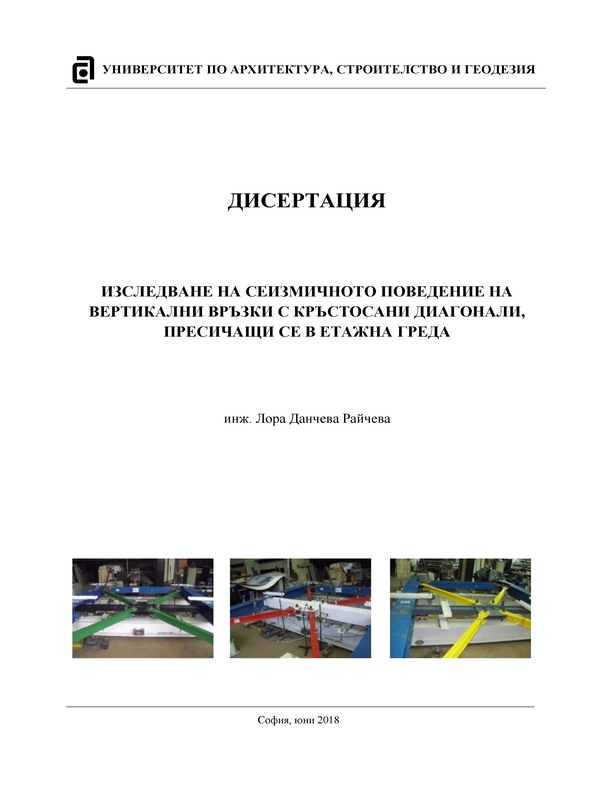
"The current paper presents a characteristic aspect of cyclic non-linear behaviour of steel concentrically braced frames with braces, intersecting into a floor beam (Split-X CBFs).
Through experimental programme three test specimens of one-bay one-storey Split-X CBF with braces of H-cross section were tested under fully reversed cyclic constant amplitude loading. The experimental observations prove the development of a distinctive mechanism of damage accumulation in braces which is presented by sequence of characteristic stages.
The typical stages of the damage accumulation process are defined and energy-based criterion for low-cycle fatigue endurance is formulated. Progressive drop in the energy dissipation capacity of the structure is observed when the accumulated damage in braces reaches a specific stage. It corresponds to brace fracture due to significant accumulation of
growing and alternating plastic strains and exhaustion of material ductility. Based on the experimental study, a numerical equation defining the relation between brace elongation and low-cycle fatigue endurance is formulated. A non-linear analysis case study and low-cycle fatigue checks are presented."
Raycheva, L., Georgiev, T. Assessment of Fatigue Damage Accumulation in Split-X Concentrically Braced Frames. София: УАСГ, 2018 с. 211 - 230,.
Raycheva, L., Georgiev, T. Assessment of Fatigue Damage Accumulation in Split-X Concentrically Braced Frames. София: УАСГ, 2018 с. 211 - 230,.
Raycheva, L., Georgiev, T. (2018) Assessment of Fatigue Damage Accumulation in Split-X Concentrically Braced Frames, София: УАСГ с. 211 - 230,.
Raycheva, L., & Georgiev, T. (2018). Assessment of Fatigue Damage Accumulation in Split-X Concentrically Braced Frames. Годишник на Университета по архитектура, строителство и геодезия - УАСГ (с. с. 211 - 230). София: УАСГ. 51 (бр. 4.).
Raycheva L, Georgiev T. Assessment of Fatigue Damage Accumulation in Split-X Concentrically Braced Frames. София: УАСГ; 2018. p. с. 211 - 230.